Vicarious Trauma Mitigation
Online Learning
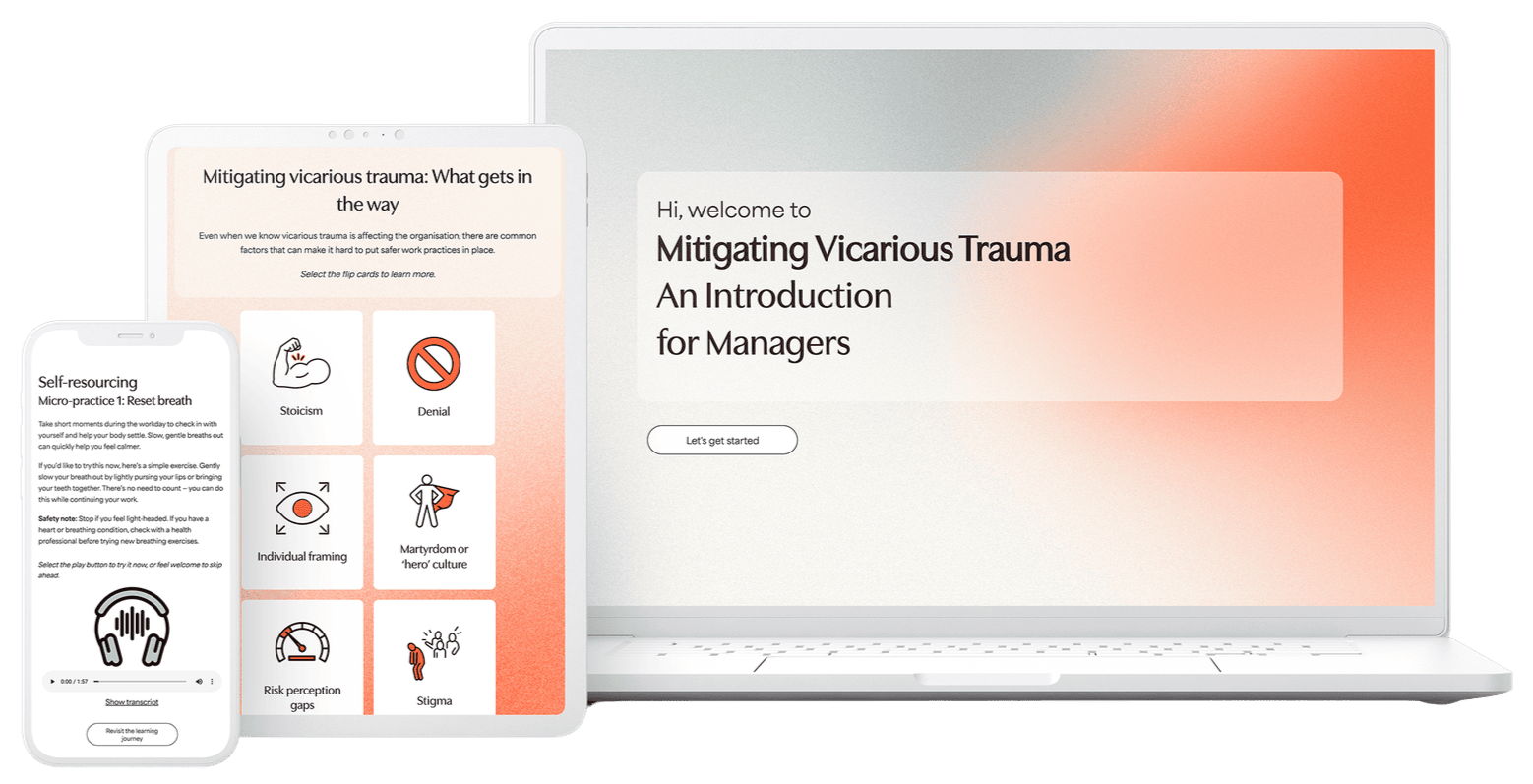
Practical, evidence-informed programs for frontline workers and managers in trauma-exposed workplaces.
Designed to build a strong foundation for understanding exposure to potentially traumatic content as a workplace hazard, and the practical steps that can be taken to reduce risk.
Self-paced, interactive, accessible, and mobile responsive.
Designed to offer clarity and build confidence in adopting safer work practices in trauma-exposed environments.
MITIGATING VICARIOUS TRAUMA:An Introduction
for trauma-exposed workers in any profession.
This 60-minute course supports trauma-exposed workers to understand exposure to potentially traumatic events, materials and content as a psychosocial hazard, and to engage in safe work practices that help mitigate the potential impacts of exposure on themselves and others.
MITIGATING VICARIOUS TRAUMA:An Extended Introduction for managers.
This 90-minute course builds on the introductory program with an additional module designed to support managers and leaders to apply a risk management approach at the organisational level.
The additional module unpacks contemporary Australian psychosocial risk regulation as it applies to vicarious trauma, with practical guidance on consultation, risk identification and assessment, the selection and implementation of control measures, and appropriate post-incident responses.
Course Structure
Both versions of the training have the same first four modules of content. The manager version has an additional fifth module.
MANAGER VERSION INCLUDES:
-
Identify exposure to traumatic events and content as an occupational hazard.
Recognise the relationship between stress and trauma exposure and the multiple mechanisms of potential injury.
Recognise the potential individual and collective impacts of vicarious trauma.
Recognise and respond to early warning signs in yourself and others.
Identify the factors that increase the risk of exposure leading to injury.
Map the mechanisms of trauma mobility in the workplace and engage in safe information-sharing practices.
Use strategies during the workday to look after your wellbeing.
Manager version – additional outcomes:
Identify opportunities to mitigate risk through improving work design and implementing effective risk control measures.
NB: The learning outcomes of these modules have been intentionally designed to align with the WorkSafe Victoria’s Compliance Code: Psychological Health (2025), reflecting the outlined inclusions for information, instruction and training relating to exposure to traumatic events or content.
-
Self-paced, eLearning hosted on the LearnWorlds LMS, allowing learners to pause, return and progress at their own pace.
Fully mobile-responsive for seamless access across desktop, tablet and mobile.
Accessible and inclusive design, aligned with WCAG 2.2 AA accessibility standards to support equitable access for all learners
Animated explainers to bring complex concepts to life.
Interactive activities.
Embedded knowledge checks to reinforce key concepts and support retention.
Guided reflective prompts to encourage personal application and insight.
Clear system-mapping visuals to support understanding of risk, flow and controls.
Downloadable PDF post-training quick reference guide.
Downloadable PDF reflection workbook to support deeper learning and ongoing practice.
-
This eLearning is grounded in a work health and safety perspective, reflecting a deliberate shift away from framing vicarious trauma as an issue of individual resilience. Instead, exposure to potentially traumatic events, content and materials is treated as a foreseeable workplace hazard that requires proactive risk awareness and safer ways of working.
While designed for individual learners, the focus is not on “coping better” or personal toughness. It centres on recognising risk, understanding how the hazard operates, and adopting practical, day-to-day work practices that reduce risk to yourself and others.
The module supports workers to build capacity for self-reflection and brief practices that help regulate the stress response across the workday, while recognising that these strategies must sit alongside, not in place of, broader risk controls.
This approach aligns with recent reforms in Australian WHS regulation regarding psychosocial risks, recognising that safe work practices must be embedded in how work is designed, organised, and managed.
-
This training has been developed for use across trauma-exposed workplaces, whether work involves primarily written material, audio-visual content, or direct engagement with trauma victim-survivors.
As part of the development process, the modules were pilot-tested with professionals from a range of sectors, including law, medicine, nursing, education, social work and psychology.
I am not based in Australia, will the course content still be relevant to me?
This training has been developed within the context of contemporary Australian psychosocial risk regulation as it applies to vicarious trauma.
For participants outside Australia, work health and safety regulation may not drive a duty-led requirement to adopt this approach. However, the program offers a practical and structured way of approaching staff wellbeing in trauma-exposed workforces, shifting the focus away from individual resilience and towards organisational risk awareness, work design, and safer ways of working.
An international version of these programs is currently in development and will be released in the coming months.
-
Individual access and payment is facilitated through LearnWorlds:
Frontline version is $110AUD.
Manager version is $150AUD.
Fees are inclusive of GST.
Organisational licensing options are available, with pricing scaled to organisational size. See below.
-
Organisational licensing options are available, with pricing scaled to organisational size.
Access can be provided via a secure online platform (LearnWorlds LMS) or integrated into your internal LMS as a SCORM package.
Customisation and white labelling options are available as part of enterprise licensing to support alignment with your organisational context.
Access to a demo version of the training is available upon request.
Recommended Implementation Approach
As a starting point, an internal pilot is recommended to support consultation with staff, as required under WHS obligations, and to ensure the training is aligned with your organisational context and workforce needs.
A pilot package is available, providing an organisational access code for a set number of users via the hosted platform. This enables you to trial the training with a team and gather feedback in practice (6-month access):
• 20 users – $1,100 (incl. GST)
• 50 users – $2,500 (incl. GST)